Friday, September 13, 2019

Movie Review - "छिछोरे"

Take college friendship from "Dil chahta hai", Nostalgia from "Rock On", zest & inspiration from "Jo jeeta Vo Sikandar", and innocent Love from "Qayamat se Qayamat Tak" - add to it just the right amount of tragedy, laughter, hope and a nail biting climax, that does not finish the movie; and yes garnish it with just the right background sound, finely narrated story and crisply cooked dialogues and very well timed comedy - resulting into a delectable, fresh, aromatic, shaken not stirred dish that leaves a pleasant tingling after taste long after you reslished it - I am talking about the movie "Chichore (छिछोरे)". 
After a long long while a movie that thoroughly entertains. No, it is not a edge of the seat thriller; No, it is not a Love story (thank God); No, it is not even a biopic; and sorry but no, it is not even a spell binding action movie. It is like - to borrow a simile from the lady in a currently popular ad - the matt finish : "ऐसा लगता है कुछ कराया नहीं है but कराया है"

If you can see the wily-nily, tipsy-topsy, iffy-buty, hook or crook, effort that I put in the first paragraph to express the amount of effort that Nitesh Tiwari put in creating this movie and then you also realise that despite all that effort, I turned out to be loser in expressing it and yet you feel very happy because of the sheer effort I put in that paragraph - you will then admire and appreciate the movie as much as I do.
The movie is about six friends from an engineering college who are brought together again by a tragedy remembering & reliving their college days, - surprised that the most loveable affair of that time has resulted in a divorce and realising how far they have come from those days. Seems familiar - isn't it? A whiff of all those movies that I named in that immense effort of a paragraph. 
Trust me - it's not familiar. I mean - Familiar nahi bhi hai aur hai bhi. Remember Matt finish. 
😊 

The soul - the "जान" - of the movie is how the experiences of the college life of these six friends have been weaved into a story of a young, hard working, aspiring boy who is on the edge. It gives the movie a purpose - delivering a powerful message. In that sense this movie goes beyond "Rock on" or "dil chahta hai". It starts on a sad, almost depressing, note but then Tiwari is able to keep it light, breezy and entertaining. The message is delivered without being preachy. That is quite an achievement.
The movie is set in a hostel of an engineering college which most Engineers my age, all my seniors and my juniors upto at least ten batches will easily relate to. The crazy things students used to do in the college especially in a hostel of those days, the funny odd pet names they get, the life long bonds they create, the affection - the fights - the pranks - the jokes - the ragging, even the campa cola and the Gold Spot in the canteen and yes that Boys and Girls Hostel thing - which is almost impossible to put in words. And Yes before I forget - the bond that one develops for his/her hostel at a college. It's almost like patriotism for your country - isn't it!?

You easily start relating to one or the other character with ones that you had in your college times. Then enters the Hostel rivalry - reminiscent in parts of "Jo Jeeta Wo Sikandar" and yet "Chichore" goes beyond. Yup it does - am tempted to tell you when - but better you discover it yourself. No wonders - only an IIT Mumbai graduate as Director could have portrayed all this so well.

The beauty of the movie is that it does not have a Hero - not even a heroine and yes no villain too. I mean all of them are not there, but they are there too. Remember, the matt finish. 
😊

The absence of a big star in the movie ensures that all characters are well developed properly introduced and very well used in the movie. And dare I say all of them played their characters rather superbly. Varun Sharma is in his full form - he is a natural at comedy. It's so effortless that he does not even appear like acting. Both "Fukrey" and "Fukrey Returns" were watchable only because of him (& Richa Chaddha). He makes this movie too a light happy one. After this movie he is added to the list of great talents that bollywood often ends up wasting in trivial roles. 

Sushant is in his elements - looking cute, responsible, helpless, fighting and confident with an uncanny ease. It's probably his best performance till now. Naveen, tushar and tahir were new faces to me and were impressive in their roles. They put life in their characters despite the limited footage that they could have got in the scheme of things. Saharsh although not popular but was a known face and, as expected, he did a fine job as "Bevda". Pratik Babbar despite his expression less face does Ok. Even shraddha kapoor does justice to her limited role in the movie and If even I start liking her in the movie it goes as really high praise for the director. In a largely male cast she makes her presence felt by that girlish look. 

Editing is so crisp that there does not appear to be even one second extra. The songs are not really hummable and are forgettable but they fit in the scheme of the movie quite well. One thing that makes a deep impact in the movie are the choice and design of the costumes. They just fit the time and environment painted in the movie. 
Dialogues so well written that they hit the right chord always. They add verve to the movie - there are many that will ring later but here are two that meant a world to me
"loser का टैग आदमी पहनता भी खुद है और उतारता भी खुद ही है" and
"अब जा  - एक loser की तरह नहीं, एक फाइटर की तरह"


Direction is just perfect - Nitesh Tiwari has turned out another winner after Dangal. However he does better than dangal by delivering a powerful message in this one. He finally found a fine balance between the fine messaging of "chillar party" and great commercial mix of "dangal" in this movie.

"
छिछोरे" has a "must watch" rating from me - so go book a ticket if you have not done it already. I have a few statutory disclosures to make - I may have associated more with the movie because of my years in the hostel of my engineering college & my hostel days at the IIML and also because I dropped my son at the door of an IIT just one and a half month back. And this does not give away the most important part of the story. Well actually I have not given away and have given away too. Remember the matt finish. 😊

Finally I left the movie hall with one regret that I did not watch this movie with my son sitting beside me in the hall. So, if you are a parent of a kid, who would soon be entering a college - don't forget to book his tickets too.

Wednesday, September 11, 2019

The "Ola-Uber"isation of Economic Slowdown

Yesterday, our Finance Minister got the twitterati abuzz with her latest explanation of Slowdown - yes, you got it right - it was because of Ola - Uber services. She really got the social circuit buzzing with her comment that “The automobile and components industry has been affected by BS 6 [norms] and the mindsets of millennial, who now prefer to have Ola and Uber rather than committing to buying an automobile,” Here are the details of what she said.

Initially the jeering of her statement built into #boyacottmillenials trending on social media. Then many also jumped in her support - claiming that she was actually right in her analysis as the trend among young people is to not buy cars. So Is she Right or not in her analysis !?

Millennials' behaviour IS different
First let's acknowledge that surely there are less millennials who wish to buy car because they find the Ola-Uber services easy, cheap and hassle free as compared to owning a car an maintaining it. There is little data to prove it but if you look around this seems to be a growing behaviour - so for a minute let's accept the trend as live and kicking

But there are many slips
The question is does this changing behaviour explain the Slowdown specially in the auto Industry. The answer is not really a surprise - here is why

One, Ola - Uber is a recent trend and can be called in its inception - it has not grown as exponentially to be able to drive a severe slowdown in the auto Industry - in fact it is negative growth in the cars segment. Ola started operations in India in 2010 and Uber in 2013 - I am sure most of us noticed that they are becoming a craze among millennials by around 2015-16 as they started reaching rung - B cities.

Two, What exactly is the reach of these services - how many cities do they operate in !? I tried searching for that data on Ola and Uber sites but it was not easily available So I did some global search and unverified reports pin that down to about 40 cities (which is also the number of Indian cities with population of more than a million) - Let's increase that number by 50% and assume they are available in 60 cities just to err on the right side of the argument. Now we have close to 4000 cities in India with population of between one Lakh and a million.

The point I am making is pretty clear; we can possibly ascribe the slowdown to Ola-Uber trend only if they have a substantial reach - but obviously they don't have the reach.


Third, The growth of Ola Uber themselves is slowing down. Yes from a growth of 90% YOY in 2016 to a meagre 4.5% in 2019.. These services too are experiencing a slowdown like companies in most other sectors. To suggest that they are the reason for slowdown in the first place is itself ingenuity at best and is plainly a distraction at its worst.

Oh !! and not just that
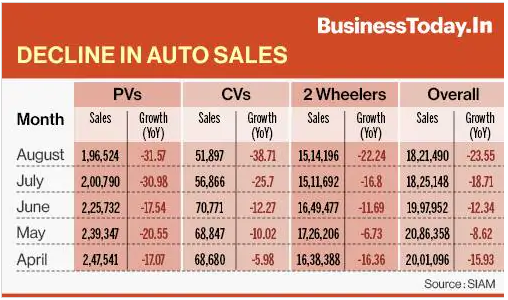
Some rational readers point out that she did not just say Ola Uber - she also said moving to BS-VI norms as the reason. Yes that's true as well. But as one would realise BS-VI is sixth such norm - we weathered through to BS-IV without such a draconian fall in sales. It is foolhardy to believe that half the buyers are waiting for BS-VI cars to get launched before buying. In fact passenger vehicles saw five straight month of YOY decline of 20 plus percent. The August figure is a scary 31% out of which cars alone saw a decline of 41% yes you read it Right. (Refer the table)


There is more to the trendThat's not the complete story - Ask her, what explains a similar decline in sales of Two wheelers (refer to the table) - Five straight months of 10+% decline yoy with August touching a 20+% decline. BTW the decline is in all segments - scooters, Bikes and Mopeds.

And how does Ola-Uber growth explain the pain in Commercial Vehicles sales (refer the same table) - Five straight months of 10+% drop yoy with August decline of 40+%.


Oh !! And what about Tractor Sales decline (refer graph) Data for current month not easily available but a simple google search will tell us that the July Sales for two major tractor manufacturers M&M and Escorts fell 10% to 11% yoy in July 2019 and for M&M 17% decline in Aug 2019.

Obviously none of these slides can be explained by Ola-Uber trends.

Ms. FM we are facing a wider slowdown
One of the bigger picture view that the FM seems to be missing in her press conference is that the slowdown is not just in auto sector but is wide and will probably go deep. Textiles is reporting closure of units, Sales of innerwears (underwears & vests), of FMCG goods, of Biscuits, of Airline Traffic - all are declining.

Help us understand how they are declining??

In summary
Author-Analyst-Columnist Vivek Kaul puts it brilliantly - "
We have managed to trivialise the entire economic slowdown around two points of Uber and Ola and millenials not buying cars. This is whataboutery at its very best." What we are facing is a lack of consumption/demand growth because people are simply spending less and why !? According to vivek simply because the economic environment around is uncertain even risky - consumers aren't confident of their economic security in the future hence they are saving - anticipating a rainy day. 

But I digress - we were discussing the Finance Minister's statement. In short and blunt opinion of mine - it is bunkum. At the best it is trying to distract from the larger problem but scaringly at its worst - it is a denial that a real problem exists in the economy.  

Saturday, August 31, 2019

5 Trillion $ Economy at 5% GDP Growth !?

The Indian economy popped up a shocker yesterday. For the first quarter of the financial year 2019-20 it slowed down to a surprising 5% - well below the street expectation of about 5.6-5.7% which itself would not have been happy. A quick look at current data.


  • Gross Value Added (GVA) slowdown to 4.9% from 5.7% last quarter;
  • Mining sector slowed down to 2.7% from an already weak 4.2% previous qrtr;Manufacturing slowed to a meagre 0.6 % compared to 3.1% in the last quarter;
  • Construction too slowed down to 5.7% from  a 7.1%;
  • financial services sector witnessed slowing down to 5.9 from 9.5%;

Only two sectors one agriculture and second "Trade, hotel, transport, communication" achieved minor positive growth. Former grew by 2% from a 0.1% and the latter stood at 7.1 up from 6% last quarter . However agriculture at 2% is laughable - given that Government is targeting doubling the farmer income by 2024.

Bad News
This is bad news - 1QFY20 is fifth consecutive quarter of declining GDP growth. The lowest in six years (four quarters). This is the lowest ever under the leadership of PM modi. Before this, the fourth quarter in 2013 saw a meagre growth of 4.3% in the last days of policy paralysis of UPA-II. However, even that comparison may not be valid because this 5% is on new data series and possibly when compared apple to apple the 4.3% of 4QFY13 was probably better.


Not Surprising
While this is bad news it is not a surprise. In many posts earlier too - I have pointed out to the impending slowdown as one after the other industrial sectors signalled severe slowdown. Read my budget analysis here

But that was recent future. I have been pointing out to declining saving rate, lack of consumption demand, stagnant exports, increasing unemployment, sluggish & incremental approach to economic reforms.

Add to them the adventure like demonetisation, incompetent handling of one major reform - the GST, Increased regulatory mindset - moving to more license raaj, killing of autonomy of major institutions, shift towards a higher tariff - higher taxation regime and it is easy to understand why the economy seems to sputtering at all levels.

Lost Opportunities
It would be easy and simplistic to blame Global environment for the slowdown All slowdowns are part cyclical. However we will be fools if we missed the fact that this slowdown is majorly structural and very poorly managed economically.

We faced a much stronger cyclical headwind way back in 2009 with much more finesse. In fact the major reform of introduction and implementation of service tax was multifold better than the implementation of GST. 


I have been pointing out that Modi Government has been the luckiest government that India ever had. It saw the longest spell of Moderate to very low oil prices, benign dollar because of slowing down of American Economy, rapidly declining chinese economy, comfortable - even strong majority in the Government, a popular and widely accepted PM.

And yet the Government failed on most major structural reforms that were badly needed - For example it failed to aggressively privatise the public sector, or it failed to boost manufacturing, it dragged its feet on cleaning the Banking NPA mess for far too long, It did nothing to mitigate the impacts of Demonetisation on the real cash economy of India. We may have been climbing the ease of doing business rankings but honestly on the ground doing business is more problematic than ever - with both costs and regulatory hurdles increasing.

On the positive side the implementation of IBC and some infrastructural focus (like roads and cleanliness) are good long term measures and will have positive impact on the economy but very poor short term management is a huge problem.

Wrong Focus

Water tight control on most institutions that should have been autonomous, managing media narrative by muting dissenting voices, obfuscating uncomfortable data to avoid fixing responsibility, living in denial about obvious problems in the economy, and blaming all troubles on past Governments as far back as that of Nehru are some of the attitudes that are beyond understanding from any rational point of view. 

Instead the government probably tried to distract attention from economic mess by raising the ante on nationalism, anti-pak rhetoric and some religious/cultural issues. It would be foolhardy however to believe that bread and butter issues will be forgotten for long in the jingoism around Nationalism. Sooner or later economy will have to be center of attention even for the voting public. 

Even on policy - the government focussed too much on revenue generation rather than boosting demand by leaving more in the hands of consuming public.
If one studied the rosy GDP growth rate data of Modi 1.0 it was largely due to Government spending - while private consumption largely remained dull and exports & manufacturing listless. The attached graph shows non-Government GDP growth rate. It comes to 4.5% for the last quarter. So we end up moving back to nineties where taxation levels rose, Baburaaj grew - taxmen seems to be knocking at everyone's doors smelling for tax evasion threatening with punitive measures. But startup India, or Make in India languish because of unfriendly policies. 

The modi style of Governance focuses on grand gala announcements often not backed up by painstaking implementation - so we had a high pitched promotion of having opened 1.2 crores jan dhan accounts in a day in 2014 but till 2019 the Direct Benefit transfer of subsidies is limited to agricultural and LPG subsidies. While we had a midnight parliament session to launch the GST - but now we are saddled with an unwieldy, poorly thought and implemented tax regime which has choked liquidity, all but killed MSME & SME and has in all probability actually increased costs. The core promise of the GST - invoice matching still remains a mirage. Similarly we had two-three years of international jamboree on "Make in India" but manufacturing in India is gasping for breath and we are losing to other asian economies in grabbing the shift of manufacturing bases from China. I can go on with this list - however suffice it to say that most initiatives lacked on the ground plan to manage teething troubles.

In sum
So here are the structural issues to address in the economy. It is not too late - the Indian economy offers huge opportunities but the Government needs to change its attitude, approach and acceptance. Incremental steps like bank recapitalisation or mergers alone will not help - we need immediate and bold steps to simplify processes, to improve liquidity, to remove interventionist governance.

Let me take two macro examples - The government aims at doubling farm income by 2024 (after having failed at doing so by 2019 earlier). This will require agriculture to grow at more than 14% annually for five years. That is impossible. Alternatively we will need to move the workforce from agriculture to services and manufacturing so that the remaining farmer's incomes double. But rising unemployment and listless manufacturing growth are suggesting that this is also just a grand announcement.

The other example is that the Government wants to reach a $5 trillion economy by 2024. This will require a nominal GDP growth of 12% consistently with a 4% inflation. We are currently at 5% GDP growth and the inflation is close to 4.3% assuming these are not fudged figures.

Will we wake up to economic realities or simply conduct another surgical strike to distract and then will chant - Vande Mataram.

Monday, July 15, 2019

Movie Review - "Super 30"

With movies like "Chillar Party "and "Queen" under his belt (despite a forgettable "shandaar") one held a lot of hope from vikas bahl's foray into a biopic. So I went to watch "Super 30" with a sense of anticipation. Add to that my association with the world of academics and of parallel education - I was personally almost excited about the movie. 

The problem for the director was that everyone knew the story - It is a story about a person alive and kicking in our current society. We know him as someone who devised and executed the concept of "Super 30" - name given to collecting and training 30 potentially sharp students from poor backgrounds for the coveted IITJEE and to get them selected to the august corridors of the IVY league of Indian education. The story is of Anand Kumar who dedicated himself to this cause and despite the seemingly insurmountable odds and resistance from all quarters, succeeds in the mission. 

So, what can the script and the director do to make the movie interesting. I think the director faced the dilemma of whether to make the movie more inspirational or more entertaining. As the director of Chillar Party and Queen - I had expected that he will find this fine balance between the two. I must say that I was a tad disappointed, just a bit disappointed, on that note. And yet he is able to keep the audience engaged for the entire length of a quarter less than three hours - which is quite an achievement. However, to keep this engagement - the director surrenders to loud overacting and melodrama, because otherwise the lack of depth in the story or the many loose ends of the movie would become obvious. 

The movie starts with the story of personal struggles of Anand Kumar who is keenly interested and is very talented in mathematics - but the infinite constraints of he being from a poor family breaks his back completely and he was almost relegated to be a faceless of crores of talented Indians who fail to make a mark. This part is well made and is indeed inspirational. It is also very real and convincing. One could feel the anguish of being a talented student among a crowd of smug, ignorant and unappreciating set of people for whom the most empathy with the guy was to get him a job in the post office. It is disheartening to see such talent go waste.

However, soon a commercial almost trivialised bollywood drama unfolds as his life changes from someone aspiring to become a PhD in mathematics to the best known face in the coaching world of the coveted IIT admission business and then transforms into a idealist out there to fight for struggles of unknown underprivileged kids.
The eternal need to have a heroine and a villain in the story of a Hero makes the movie look like a fictional - less convincing - bollywood commercial film in the second half. I would say Mr. India released wayback in 1987 had portrayed the struggles of a man supporting the kids better without a biopic. So there is a "Mogambo" - the CEO of a large coaching business who does everything on and off the book, most unconvincingly though, to kill the Anand Kumar story. Then there is the "calendar" - the brother of Anand Kumar who is beside him in his thick and thin - nondescript but a stellar support. Oh !! and can I forget "Seema" the heroine of Mr. India trying to bring about some "namak" in an otherwise plain daal-rice story of a struggler. And yes - it was needed that the Army of the "Mogambo" will fight a head-on battle with the hero and eventually lose it to an unexpectedly smart and well equipped set of poor starving kids.

{For the uninitiated Mogambo, Calendar and Seema the reporter are unforgettable characters of an immensely successful shekhar kapur superhit "Mr. India" - the parallels to that movie of Super thirty are uncanny} 

My problem is not, that these stories are fictional - we all know that they are actually true. That Anand Kumar was shot at, almost killed. That when he was in the hospital - he was attacked by a gang of goons - but the flight of fancy that the director took in picturisation of this sequence turns the movie into a rajnikantish manmohan desai flick minus the imaginative fine execution of either manmohan desai or shekhar kapur. While one was expecting a very real and earthly "chillar party" style of handling those sequences by the Director of that immensely likeable  movie.

My problem is also that to turn the protagonist into super hero everyone else is willified and looked down at. So the entire coaching business is education mafia, the entire rich class students and privileged and hence shown as someone grabbing opportunities of the poorer students. That there is no financial or other support to the poorer students of the society that they are almost completely exploited lot. Such caricatures actually increases the distance between the haves and have nots in their psychology. It also builds the perception that only rebellion against such exploitation is the way out for the downtrodden. I think the world around us had changed a lot. 

There are far too many loose ends - a don calling the protagonist from a Bihar jail asking for a cut or closing down his class is simply told on the phone that none is happening and then he does nothing; just vanishes in thin air. The sequence in which the Super thirty competes with the students of Excellence, are defeated and then are saved from closing the venture down was a pathetic attempt to make the heroine relevant. I think that was the weakest part of the script. The English play by the Hindi/bihari speaking students to gain confidence among the elite english speaking student was another unconvincing drag of the sort, while it tried to convey an excellent message actually. Even the attempt to murder the protagonist is stretched and so spills over to look quite unreal. The most unreal part happens to be the climax sequence in which the students of Anand Kumar gangs up to save him from an attack on the hospital. The effort to show that they used the concepts learnt in the classes in dealing with these goons is interesting but unreal.

On the positive side - the academic brilliance of Anand Kumar has been imaginatively captured and picturised. The need for a teacher to go beyond the subject and delve into the psyche of the student and help him/her in areas beyond the subject is well sketched and presented. The unholy nexus between education, politicians and goons is real and palpably presented. The sequence when the kids finally succeeds is very well cultivated and leaves us poignantly happy.

Hrithik Roshan is intense and sincere as always. He played the Anand Kumar rather well. He only looks unconvincing when trying to portray the helplessness of Anand Kumar - like when he sells Papad or when he goes for help to the coaching class CEO. The problem with most Hrithik Roshan movies is that his character dominates the movie so much that most other characters remain underdeveloped. So, despite an almost three hour long movie - most other characters remain distant and obscure for the audience. Mrunal did a fine job of whatever little she was given to do. Virendra Saxena and Pankaj Tripathi both leave a mark in very limited roles that they were allowed. Aditya srivastava through a  fine actor was a victim of underdeveloped character. To keep Anand Kumar as a hero he was sketched as a weak, acute kind of a leader who has little idea of what he was doing and often fails in execution. On the other hand - he is also someone who converted Anand Kumar into a brand. Really !? The group of kids were underwhelmingly developed. The movie tried to paint these kids successes as and only because of Anand Kumar. 

Honestly the background music is a disappointment - nothing really is hummable or memorable. It is at places loud and uncomfortable - specially the Hindi Play song "no no no .............". Even the dialogues could have been far better. That would have lent more power to the movie and were badly missing. Only the one where Anand kumar says "
ये अमीर लोग अपने लिए खूब चिकना सड़क बनाए, हमारी राह में ऐसा बड़ा-बड़ा गड्ढ़ा खोद दिए. लेकिन यहीं वो सबसे बड़ी गलती कर दिए. हमको छल्लांग लगाना सिखा दिए." leaves you with some jest. In fact the signature dialogue "आज राजा का बेटा राजा नहीं बनेगा. राजा वहीं बनेगा जो हकदार होगा" repeated many times sounds cliched and devoid of any impact.

So then if you have read this review till now, you will ask me why am I saying it is a good movie to watch - probably because of Hrithik and because it's an entertaining movie. Don't look for too much inspiration - it is there in bits and pieces but you are fairly entertained with loud music, acting and delivery. It's not quite in the class of Milkha Singh or Mary Kom. It tries to be three Idiots but is miles away from it. And yet its a good one time watch. It does bring out the disparity and unfair competition. Don't look for an inspirational biopic - instead look for a superhero who sacrifices himself to create success out of hopeless poodles. Don't look for a commercial pot-boiler on the edge of the seat entertainment - but enjoy the emotional, often loud picturisation of human misery, glory, frustrations, successes and the myriad puzzle called life. Good one time watch. If someone was to watch it a second time - there will be too many flaws obvious.

Saturday, July 06, 2019

Budget 2019 - Huge expectations - negative delivery

As the first full-time lady Finance minister of Independent India, N. Sitharaman has a lot to be proud of. For India as a country too this is sort of a milestone - female power busting another historically male dominated domain. 


Having said that, her record either as the Commerce Minister or as the defence minister has been a disaster. So one was disappointed to see her becoming the Finance Minister at a very important juncture for the Indian Economy. She is one more in the series of appointments under the Modi government who is in her position because of an unflinching loyalty to the king.

Be it what it may, did she do something to change my perception of her in the Full Budget presented on 5th July 2019 (if we still think that Piyush Goyal presented just a vote on account in Feb, that is) Let's do some detailed analysis. 


Background
One sympathises with Nirmalaji because she inherited an economy that is largely in a mess and she cannot now blame the previous Government too (well magic !? the previous government was also her own - times change don't they). 


Arun Jaitley will probably go in the annuls (at least that's my opinion of him as the FM) as a Finance Minister adept at managing media narratives but who did little to reform or restructure the Indian economy in its most crucial decade and as someone who lied his way through his entire tenure - on data (Fiscal Deficit/Disinvestment for eg), on narratives (demo for cashlessness for eg) too. He missed on an opportunity to radically restructure/reform the economy.

So what does Nirmala Sitharaman inherit from him as an economyAn NPA mess in the Banking Sector
A Banking system that is burdened with an NPA (Non-Performing Assets) mess. According to the MOF data the gross NPA more than tripled from below 3 lakh crores to more than 9 lakh crores.  Yes, these NPAs are a legacy of the UPA era. However, Jaitley failed to address the mess and mitigate the crisis despite pumping in record amount of money in the financial system. Five years down the line the NPA balloon is more inflated. This despite the fact that there has been record recovery of Loans due to pressures built by the IBC (Insolvency and Bankruptcy code) act and also despite the fact that the Government has been pumping money (Remember the Indrdhanush scheme of Jaitley that was supposed to solve the NPA issue) that is growing in every budget.

A shadow banking crisis 
The non banking Financial Institutions (NBFC), often called the shadow banks as they operate approximately like a bank but without the strong RBI regulations unlike banks, are undergoing a crisis of their own - which is still unfolding. The default on bond repayments by ILFS  that alone holds more than 91,000 crores of debt has raised alarms as more than 1 Lakh crores of CP are coming up for redemption in the next three months. There is severe liquidity crunch. Read details here.


A Data Credibility Crisis
For many years now reams of paper have been written questioning the new GDP series data that is showing robust growth in the GDP while most other economic indicators like export, consumption, savings and jobs have been showing a decline. In fact on many occasions the Government stopped publication of data, or delayed release of reports or simply hid the data behind bureaucratic walls to keep the narrative positive. However now there is increased discussion on the issue.

There was a celebrated leakage of unemployment report from the NSSO that showed unemployment at an all time high which NITI aayog had termed as unofficial. However now the data is official and the unemployment rate indeed is at a 45 year high


The former chief economic advisor to the Modi Government has written a research paper that claims that the Indian GDP growth rate may have been overestimated by as much as 2.5% and so claims that the GDP growth rate may actually have been between 3.5% to 5.% and not close to 7% as estimated. While this has been disputed - no cogent analytical defense has been put to counter this by the Government. However even the Economic survey has accepted a slightly downward revision of GDP estimates.

Economy slowing down
After initial state of denial the Government has now accepted that the economy is indeed slowing down. The Quarterly GDP growth rate in the last two quarters of 2018-19 were 6.6% and 5.8% respectively. 


Not necessarily Fiscally "prudent"
One of the credits that Jaitley has always given to himself is that under his stewardship the fiscal deficit has been under control and has largely kept to the roadmap decided upon in the last Chidambaram Budget. On paper this looks like true too. The government estimates 3.4% fiscal deficit as against a target of 3.3%. This does not look bad at all - but is it possible??

Specially because the Government revenues from almost all sources fell below its target (budgeted revenues). This is true even on account of direct taxes which otherwise have risen robustly. So much so that the Government fell short of budgeted revenues of close to 1.5 Trillion rs. - yes thats 1.5 Lakh Crores. So how did government manage the fiscal deficit figure by cutting spends in the last quarter, delaying payments in the last month of the year and hence the payment was made after April and managing subsidies levels by keeping them on off balance sheet items for example loans taken by FCI to pay for those subsidies which will have to be paid by the Government in the next financial year but that helped them keep the value away from govt balance sheet for the current financial year. Read a more detailed account of this jugglery here. 

The government also showed better collection on the disinvestment front but even that was jugglery because it generated money by cross disinvestment (meaning one PSU buying another). This generates money for the govt but does not address the basic problem of loss making PSUs eating way government resources. Also the new MPC with the last dissenter Viral Acharya having resigned is more amenable to offer higher dividends to the govt to fill the gap. But as you may have understood none of these is a structural improvement in the management of the economy.

The nut and shell of the above mumbo-jumbo is that the real fiscal deficit is much higher and that the government show of fiscal prudence is largely window dressing.

Stagnant/declining exports
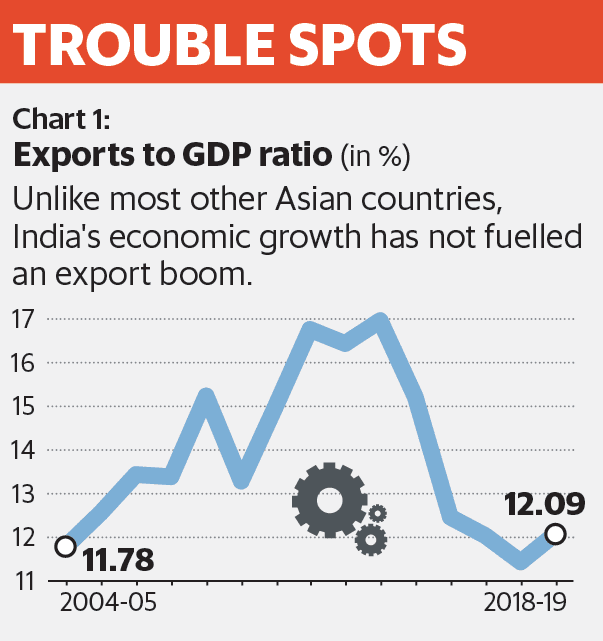
The exports sector has been languishing for more than half a decade now. There has been no economy in the history that has grown at 8+ percent without a robust export scenario. This is one area where the Government also has not tried to hide data (as if they could have) but at the same time has done precious little to boost it up. One of the reasons I find Sitharaman a wrong person for the FM' job is her failure to do anything on this front as the commerce minister. Our export to GDP ratio needs to improve if we are serious about 8+% growth.


Consumption slowdown is real and large
In March 2019, sales of cars, motorcycles, scooters, commercial vehicles (CVs) and tractors fell in comparison to March 2018. They fell by 6.87%, 14.27%, 25.19%, 4.71% and 14.97%, respectively. Data over the last five years (between April 2014 and March 2019) shows this is only the second time when growth of all five economic indicators has fallen during the course of a month. Before March, the only other time this had happened was in February 2019, when sales of cars, motorcycles, scooters, CVs and tractors dropped by 4.33%, 0.58%, 12.14%, 8.77% and 0.52%, respectively. (Data : Mint). The economic survey now accepts this severity in slowdown.

Private Investment stagnant/declining 

One real headache have been lack of enthusiasm among corporate to bring about robust investment in private businesses. This despite push to Make in India, Improved ease of doing business, and focus on startup india. Probably this is an indication of lack of confidence in the Indian economy for now. This may also be because of after-shock of demonetisation and a patchy implementation of the GST regime. Fresh investment in the economy has plunged to a 15 year low. 

Household Saving declining

A robust private investment requires availability of fund in the economy to invest. Out of many indicators that point to availability of funds to invest is the savings rate of the economy. The historically high domestic saving rate in India has been steadily declining and that should worry policy makers because it is an indication of investments that can happen in the future of the economy.


Is there something positive in the scenario ??
Obviously yes, there are a few - 
For one our fiscal deficit may not be as rosy as Government makes it look but it isn't something to be worried too. A more honest government would have accepted that there are headwinds and so to stimulate growth certain substantial slippages in fiscal prudence has been allowed to happen. 

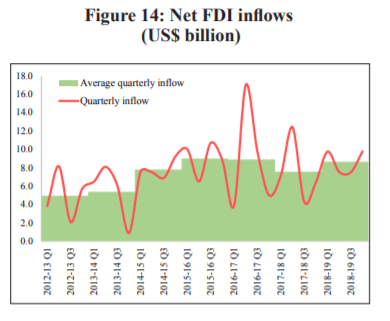
Second, despite low exports the Forex reserve situation is not just comfortable but has been further growing too. So we are nowhere near the 1999 situation. This has been possible because of steady FDI inflows in the economy. We have been helped on this account because of Global economic slowdown followed by Quantitative Easing in the US and the Europe, is my guess.

Third positive is that inflation is well under control - this has largely been because of strong monetary policy control under RRR followed by urjit. The MPC  without viral may not be so hawk eyed anymore. 

The other positive is that oil prices remain moderate and hence government is able to generate a bounty of sorts in taxes on petrol/diesel. The only six months when the crude had started climbing in 2018 is when modiji for the first time started to appear a weak PM. So in that sense modi government has been very very lucky. 

Final positive is that the infrastructure spending under modi 1.0 is real and widespread. One can expect it to kick in sooner or later. FM must be badly hoping that it kickstarts the consumption.

I can go on and on (for example I did not mention agriculture distress because it is so much talked about) but I think you get a drift of the economic mess that Jaitley left us with. Is this time running out - only time will tell. 

But one thing I can say for sure. A supposedly economically right wing government with brutal majority in the house should now not be incremental about economic reforms - otherwise our demographic dividend, the economic sweet spot that we have been at for almost a decade now, and the real opportunity to grow and become a world power will truly be missed. My fear is that Sitharaman is not the person to trust with such a humongous task and I will be happy if proven wrong. But at least now she cannot hide behind the names of Nehru, Gandhi and Manmohan Singh for her woes.

What does budget deliver 
Disappointment in nutshell. The budget actually cements the perception that N Sitharaman is an overrated minister - she hasn't performed in any capacity and that there is no expectations from her as the FM as well

The budget actually simply continues the trend of overestimating revenues - aready the Government has fallen short of revenues in all front but the budget estimates a 20% jump in collections over the last year's unmet targets by a huge gap I showed above how economy seems to be sloeing down everywhere - this 20% jump is almost an impossibility.

To generate these impossible figures - all kind of bad economic ideas are back
1 The cess on FPIs is a retrograde measure - will only lead to volatile and negative sentiments on the stock market.
2. The extra tax on super rich is a walk back to years when high effective tax rates led to wide tax evasion and flight of capital to tax heavens. In fact it is not even clear how the additional will help because it cannot be substantial amount even.
3. Criminal charges and punitive action on failing to utilise the CSR fund mandated by law is out of dictators book. Government departments routinely miss utilising funds that they get towards development expenditure - by this logic all of them should be prosecuted under criminal laws. This is insane - criminalising a civil offence - in fact to me this is not even an offence
4 Government borrowing from International markets is a very very bad idea. Someone should make the FM read the history of east asian economies their boom based on foreign borrowings and then their overnight meltdown. In India where governments of all hues and cries have been irresponsible and opaque about the quality of their spending - borrowing overseas is sure recipe for disaster.
5. Government finally seems to be waking up to the enormity of the NPA mess and so has allocated lion's share to recapitalising of PSU banks. However required this step is - it means the government will have further less to spend on developmental expenses.

Very bad budget overall.

All in all the budget fails to understand the mess

Wednesday, July 03, 2019

Movie Review - "Article 15"

Anubhav sinha had delivered a very impressive "mulk" last year. (My review here) and so I was looking forward to "Article 15" with much anticipation. Unlike the mulk experience - this time around, one knew the theme of the movie. Also now one was entering the movie hall with more expectations from the director. So it was difficult to be surprised. 

So as I walked out of the theatre, I feel that Anubhav Sinha has delivered another well crafted movie on a very sensitive, if not controversial, subject. He confronts us again with difficult questions and helps us visit our and society's prejudices in a dignified, balanced manner. Based on the Badaun Gang rape murder case deep in the UP heartland the movie is a difficult and disturbing watch right from the word go.

A young educated urbane elite IPS officer is transferred to a typical UP village post where he is confronted with a case of three missing teenage girls, a prejudiced, rotten and broken policing & administrative system and caste discrimination so deep rooted that it is almost a culture accepted by both the discriminator and the discriminated. The story is a meandering, moving tale of this officer's experience of negotiating through this case coming to terms with the "in the face" realities of life in the hinterland so removed from the liberal - mostly just environments we live in. One could call it a crime thriller but it is actually a social comment more than a who done it mystery.

A few sequences, hopefully, will haunt the guilty conscious of audience for some time - like the two hapless girls in a bus, or the image of them hanging from a tree or when the third girl is eventually found or a sweeper cleaning a gutter are images that should be remembered as scars on our society at large. As we draw close to the end we start feeling as hopeless as the lady doctor in the
Government hospital, or the witnesses of the crime who are part of the system, or finally the lone fighter protagonist in the movie.

The movie remains focussed on the story and the theme 
throughout never taking a break to relax or divert - and to the credit of the director - despite this razor sharp focus the audience remain engaged in this difficult to narrate story. The director takes no help from song, dance or special effect sequences. There were so many instances when the director could have lost his way and could have made the movie a commercial pot boiler but thankfully that does not happen. He directed the movie with someone who wanted to make a powerful statement. The only regret will be the statement could have been delivered more powerfully but for the choice of Ayushman for the protagonist role.

I think the biggest weakness of the movie is Ayushman Khurana - a more powerful actor in this role would have made this movie much much higher on impact. Ayushman is sincere, works hard on the role but I think he simply isn't a great actor. He is more suitable to breezy, chocolaty roles. He is impressive in "Article 15" but "Mulk" was more powerful simply because its cast was better chosen. 


"Article 15", I think carried itself on the shoulders of Sayani gupta, Kumud Mishra and Manoj Pawha. In fact Manoj pawha is yet another example of how some really great talent is wasted in the Bollywood in frivolous routine roles. He spurns another super performance in his understated and non-descript role quite like he did in Mulk. Isha Talwar did not have a role and one wonders why she did the movie - probably because it was offered to her. Rest of the cast had little to register their presence as this was a Hero's movie.


The director is ably supported by the right mix of background music, good cinematography and a powerful script laced with crisp dialogues. All in all a very good movie yet again by Anubhav Sinha - he looks like someone who is all set to write off his forgettable past with uninspiring initial movies. The strongest positive of "article 15" is that it is not a super hero movie - the protagonist is a real police officer limited by constraints and needs help. He is no rajanikant who magically sets things right. While the movie ends on a positive note - one feels that was the only fictional part of the story.

My recommendation for a good watch - do add to your list - just don't go when you are in the mood for a light hearted, breezy flick. Instead, expect a engrossing, mind stirring - real tale of the contradictions in the Indian life. 


Oh !! And before I forget there is a really good rap at the end - do watch it to release some of the tense knots that you may have developed watching a disturbing but well crafted story. Enjoy !! 

Wednesday, May 08, 2019

Notice the NOTA

Recently I suggested to a friend that I am considering using the NOTA (None of the above) button this election. His reaction surprised me - he went into a monologue of how NOTA is like wasting your vote etc. I will not bore you with the details as you must have heard of how using the NOTA option is a total waste of your franchise etc. However that interaction got me thinking and I concluded that most people opposing NOTA option in our election process either lack clear thinking or are plainly being politically biased. Here is what I think

First let's get our facts right
NOTA currently does not have any electoral value. It means that even if NOTA gets majority vote a real candidate contesting with the next highest number of votes will be declared elected. In the EVM world of elections - this is an option equivalent to casting a paper vote without stamping any of the choices.

So then, why am I even discussing NOTA as an option.

NOTA is a message from the voter to all Parties
Think of NOTA as a message to all parties that we are unhappy with the choice of candidates offered by them in our constituency. Think of it as a pressure group asking political parties to do more due diligence in choosing and offering us with a candidate with better merit.

It also is a signal that we as electorate will not be satisfied with choosing the better of many bad candidates offered to us. It is a message that we are now more ambitious, more demanding and more imaginative in our expectations.

When NOTA starts attracting more number of votes it can result into one or more of the following many possibilities 


(a) It can make the political parties sit and do the arithmetic as to how these votes can affect their chances of win/lose. Obviously that will result into they applying their minds better to choosing better quality candidates.


(b) It can encourage meritorious candidates who wish to make a difference by creating an impact in public life but are overwhelmed by the need to be a part of the decapitated system, structure and processes of mainstream political parties.


(c) On a more idealistic note - it can result into many other smaller parties to erupt from nowhere in search of satisfying these dissatisfied voters.


(d) It may make our policy makers sit up and define a political process that may run into many stages so that a candidate is actually chosen by real majority (that is he/she must defeat NOTA as option as well)

(e) At the least it should make our political parties involve the local public more in choice of candidates.


(f) It may also signal an end to elections being referendum on a person/party like a presidential elections and it may shift the focus to local issues - which should happen in a truly federal democracy.

Difference between indifferent and disappointed citizen

A back of the paper calculation will tell us that between 30 to 50% of electorate does not vote currently. There are primarily three categories of people who do not vote -
One, those who do not yet know their right to vote, do not yet understand their duty to vote and do not realise the power of their vote.
Two, those who are disappointed by our democratic choices offered and hence do not go to the polling booths
Three, indifferent people who don't care.

Most of you would agree that the first category is declining steadily as India becomes more and more politically aware and vocal country. And that there will always be a small percentage that will remain in the third category.

NOTA however is a powerful option for the second category. These politically active and concerned category should go out and at least register a NOTA. This shall ensure that they participate in the democratic process and register their point of view - however much we may dislike their disappointment. Further, it reduces the chances of bogus voting in their names.

But voting NOTA may get the worse candidate chosen 

This is the most often given argument against NOTA and nothing can be more laughable an argument. This argument assumes that bereft of those people who do not feel good about all the candidates on offer - the majority was in fact with the worse choice. And if this was true why do we call that candidate the worse choice !?

Then why do so many people oppose NOTA

If you ask me this question, my answer would be - "No idea". Because most people whom I have heard opposing NOTA offer some vague - "NOTA is a waste of your vote" or that "NOTA is like dereliction of your duty as a citizen" or some such phrase without offering a reason or logic to such flat judgements.

I realised that most people (not all however) resist NOTA because their mental arithmetic tells them that more people choosing NOTA may lead to the
ir favourite candidates losing the election. This of course is then a farce to discuss with such biases. 

The only valid argument currently is that NOTA votes do not have an electoral value as of now. However, your vote to NOTA is still a message to those who should but do not care for what you feel about the choices you are offered as your leaders.

So. am I suggesting you to vote NOTA??

No, surely not. I neither advocate nor oppose NOTA. When you make up your mind on whom to vote for - keep NOTA as a valid option. Weigh your choices - decide on the best candidate out of the given GOOD choices. However, I am surely suggesting Do NOT choose the better of the bad alternatives. If you feel that the candidates offered are not even of acceptable quality - go out and press the NOTA button. The point is simple NOTA is a valid option for every voter.

One last thing - whatever you do - whomever you choose - even if you choose NOTA, please do go out and vote. Because we must matter. 

Monday, May 06, 2019

The curious case of ONGC

One of the things that our Finance Minister Arun Jaitley proudly tweets, blogs and speaks about is the fine management of economy his ministry has purportedly done - by broadly keeping it to the declared objective of fiscal prudence. However a simple bird's eye view will puncture many holes in that achievement. 

Let's start with meeting the disinvestment target by the Government. One news story caught my eye. One of the Navratna PSUs ONGC's (Oil and Natural Gas Corporation) cash reserves have depleted by 98%, down from Rs 9,511 crore in March 2017 to Rs 167 crore in Sept 2018. On the other hand by the end of Financial year 2018 the debt on the company was close to 25000 crores. 

What has this to do with fiscal prudence of Jaitley's budgeting skills. Well ONGC is a living example of accounting jugglery of Jaitley's finance ministry to make the Government balance sheet look good and he can also claim meeting disinvestment targets in front of cameras. But here is the catch - this is not disinvestment at all. It is squeezing cash out of the company to bolster Government balance sheet. And ONGC is not alone. 

You see - a genuine attempt to disinvest Air-India failed abjectly. Even the great modi government could not get it done. So then the government did not even try to move ahead on other ailing PSUs like the IDBI bank. LIC - a 100% government ownership company was made to invest in IDBI bank - which announced a loss of 13000 crores in that financial year. And then Government made ONGC buy its stake in HPCL  for which ONGC - an almost debt free company had to raise huge debt. This is at best cross-disinvestment. One Government company buys shares of another government company from the Government. Now the ownership of HPCL as a result has been transferred to ONGC from the government but wait ONGC is owned by the Government. In short - ONGC was made to pay cash to the Government. This is despite the fact that ONGC made a dividend payment which was also a 1000 odd crores more than the last year. Of Course in all such transactions - the retail investor saw his value get destroyed because of such poor corporate Governance. So ONGC lost about 37% of its market capitalisation in the Modi years. 

And by the way - ONGC was supposed to raise its crude oil production meanwhile - however for the last five years as well the decline its crude production continued as was the case before 2014 too. All in all then this constraints ONGC's ability to actively drill for more oil in the immediate future which also thus caps its possible value creation. It has seen a recent improvement in crude production in the last financial year.

And no, this is not all of the jugglery of Jaitleyji did to manage the fiscal deficit on his books. FCI was forced to take loans to cover for food subsidies that remain unpaid in the financial year 2018-19 to the extent of about 60,000 crores. In simple terms what it means is that he shifted a liability that should have appeared on the government books to a PSU book. This of course remains a burden to paid next year. 

Not just that - after a lot of push and pulls and resistance from the RBI Jaitleyji was also successful in getting the RBI to trasfer a surplus of Rs 50000 crores denting the cash reserves with the RBI too. All in all the government has been shoring up cash from all ways and means keeping the corporate governance so close to Modiji's heart aside.

Why would all these be needed - because the announcement and implementation of various schemes left right and center needs to be funded. While, after all the tax reforms that Jaitleyji claims to have done, the tax mop-up of the Government fell short by a shocking 1.6 trillion rupees from the budget value in 2018-19. The 2019-20 budget actually expects to collect a figure higher than this missed budgeted figure by a 10 plus percent.

So, in short the government seems to be bleeding cash from PSUs, cross disinvesting to generate money, pushed the RBI to transfer higher surplus and failed to mop up budgeted taxes by a huge margins. What this concludes to is that the harmless looking revision of fiscal deficit from a budgeted 3.3% (which was also higher than committed three years ago) to 3.4% is also jugglery. The actual fiscal deficit is much larger and most probably will figure either in revised numbers or next year's budget. In fact looking at the gap in tax mop-ups the revised figure of GDP growth rate of 7% also looks doubtful. This (mis)management of course will have to be paid by the tax payers and share holders and investors in PSUs and LIC etc. 


No wonder then that modi government is pitching this election not on "vikas" but on "Nationalism" and "religious" tone. What is interesting is that Modiji seems to be winning anyways. Enjoy the ride.